Ankle Sprains: What They Are, Why They Happen, and How to Rehab Them the Right Way
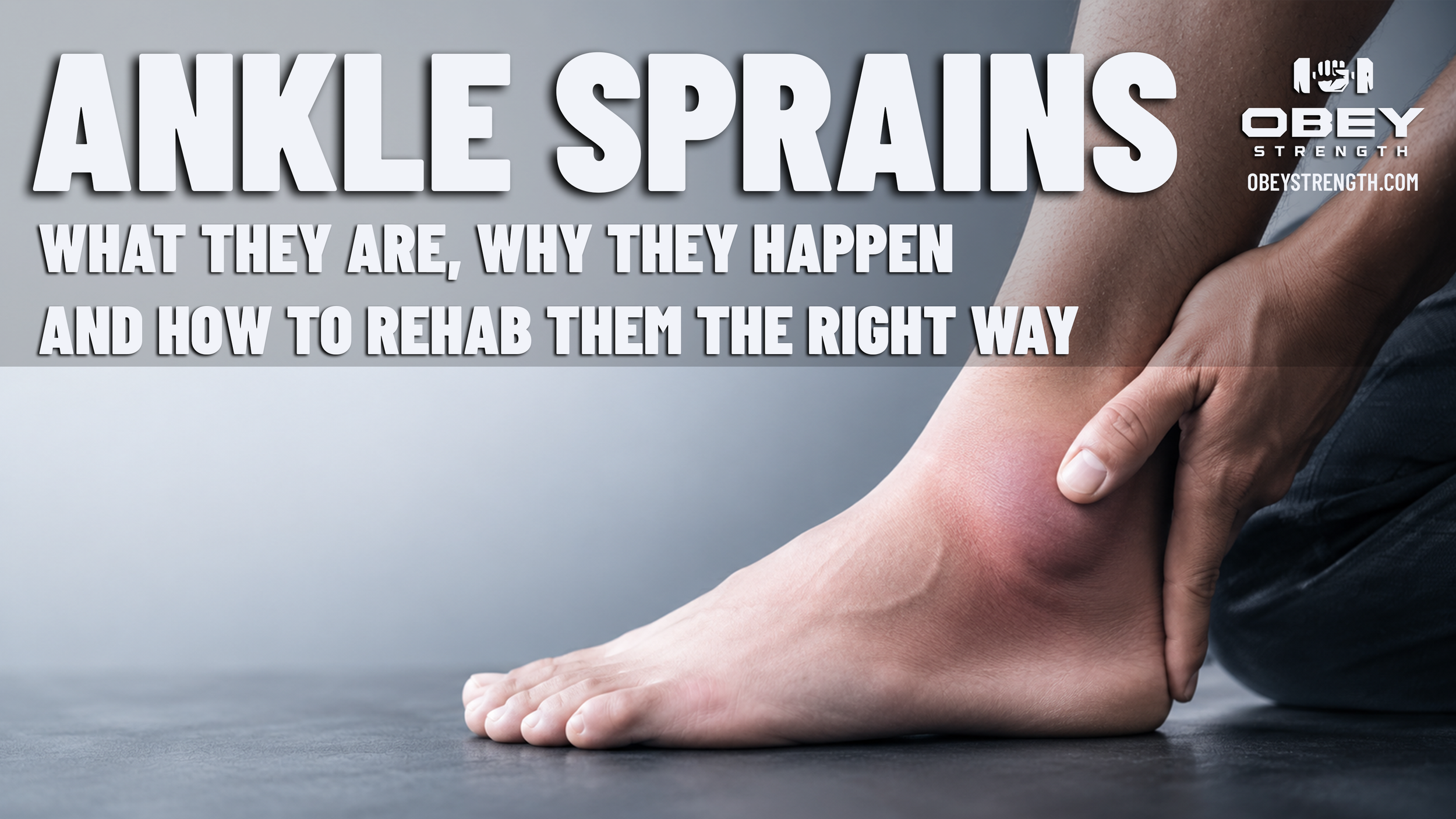
Rolling your ankle can happen fast. One bad step off a curb, one awkward landing during a workout, one quick change of direction in sport, and now your ankle is swollen, painful, stiff, and making every step annoying.
As a physical therapist, ankle sprains are one of the most common injuries I see. They happen in athletes, runners, lifters, pickleball players, and everyday people just trying to live life. The problem is that many people treat them too casually. They take it as “just a simple ankle sprain” and assume they only need a few days of rest. But if the ankle never regains its motion, strength, balance, and confidence, that “simple ankle sprain” can turn into repeat injuries and long-term instability. Up to 40% of people can develop chronic ankle instability after a first-time lateral ankle sprain.
In this article, I’ll break down what an ankle sprain is, the different types, the common structures involved, signs and symptoms, mechanism of injury, pain management, and the rehab exercises and tools I commonly recommend.
What is an ankle sprain?
An ankle sprain is an injury to one or more ligaments around the ankle. Ligaments are strong connective tissues that connect one bone to another and help stabilize joints. I always explain to my clients that ligaments are like strong tape that holds two bones together. When the ankle twists or pulls beyond what those ligaments can withstand, they can become stretched, partially torn, or fully torn, resulting in a sprain.
This is different from a strain, which refers to injury of a muscle or tendon.
Why ankle sprains matter
A lot of people recover well from ankle sprains. But many people also never fully rehab them.
That is where problems start. The swelling goes down, they can walk again, and they assume they are good. But then months later they still feel stiffness, weakness, poor balance, pain with running, or that feeling that the ankle might “give way.” Chronic ankle instability is a real issue and often develops when the original sprain was not fully restored from a movement and strength standpoint.
That’s why I don't look at ankle rehab as just “calm the pain down.” I look at it as restoring the ankle so it can tolerate real life again.
Ankle anatomy: the commonly injured structures
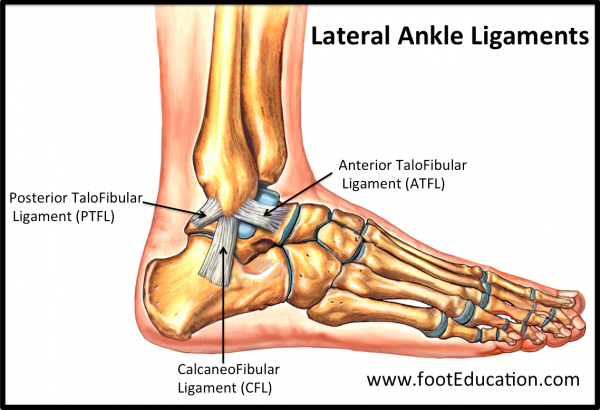
The most commonly sprained ligaments are on the outside of the ankle, which is why most ankle sprains are called lateral ankle sprains. The main lateral ligament complex includes the:
Anterior talofibular ligament (ATFL)
This is the most commonly injured ligament in a typical ankle sprain. It is especially vulnerable when the foot rolls inward (inversion), and the ankle is slightly pointed down (plantarflexion).
Calcaneofibular ligament (CFL)
This is another commonly injured ligament, often involved in moderate or more significant sprains.
Posterior talofibular ligament (PTFL)
This one is less commonly injured and is more often involved in more severe ankle trauma.
Source: Regenex
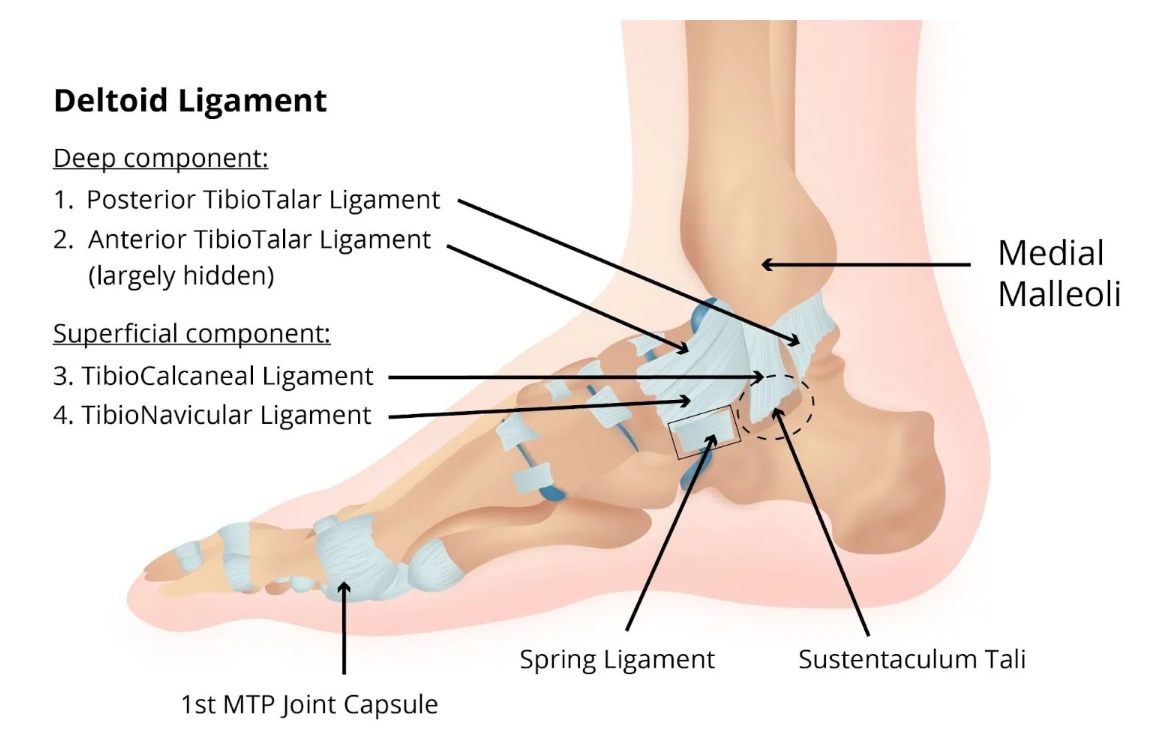
Deltoid ligament
This is the major ligament complex on the inside of the ankle, or medial side. It is composed of a strong triangular complex composed of four main ligaments:
Posterior Tibiotalar Ligament
Anterior Tibiotalar Ligament
Tibiocalcaneal Ligament
Tibionavicular Ligament
Medial ankle sprains can involve these structures, but they are less common than lateral sprains.
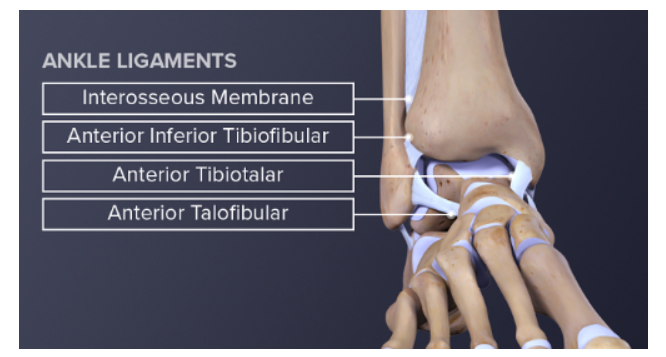
Syndesmotic ligaments
These ligaments connect the tibia and fibula above the ankle joint. Injury here is called a high ankle sprain, and these injuries usually take longer to recover than a standard lateral ankle sprain.
These ligaments include:
Anterior Inferior Tibiofibular Ligament (AITFL)
Posterior Inferior Tibiofibular Ligament (PITFL)
Inferior Transverse Ligament (ITL)
Interosseous Ligament (IOL)
For Physical Therapy students, it is worth remembering that not every ankle sprain is just a ligament problem. Depending on the severity and mechanism, the injury may also involve the joint capsule, tendons, cartilage, bone bruising, or even fracture.
Types of ankle sprains
1. Lateral ankle sprain
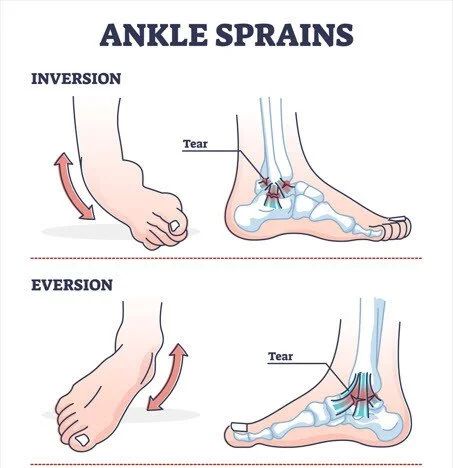
This is the most common type. It usually happens when the foot rolls inward underneath the body. The ATFL is most commonly involved, and the CFL may also be injured depending on the severity.
2. Medial ankle sprain
This happens on the inside of the ankle and involves the deltoid ligament. It is less common because the deltoid ligament is stronger and less commonly overloaded.
3. High ankle sprain
This involves the syndesmosis between the tibia and fibula. These injuries often happen when the foot is planted and the lower leg rotates. High ankle sprains can be more stubborn and slower to return to sport.
Grades of ankle sprain
Sprains are often graded to help identify severity.
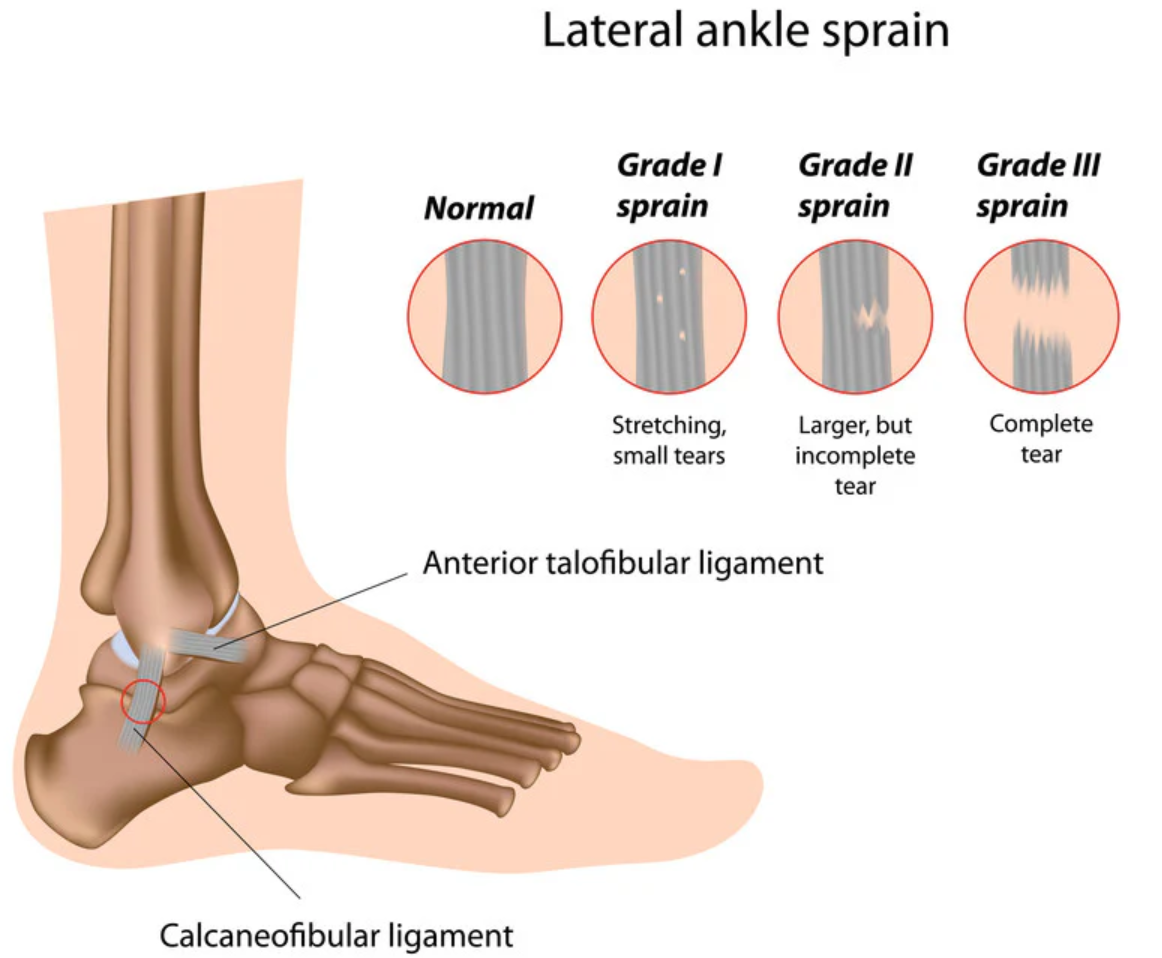
Grade 1 ankle sprain
A mild sprain. The ligament is overstretched, with minimal tearing. There is usually mild swelling, pain, and limited functional loss.
Grade 2 ankle sprain
A moderate sprain. This usually means a partial ligament tear, with increased swelling, bruising, pain, and difficulty walking.
Grade 3 ankle sprain
A severe sprain. This can involve a complete ligament tear, significant swelling and bruising, instability, and greater loss of function.
Signs and symptoms of an ankle sprain
Common ankle sprain symptoms include:
pain around the ankle
swelling
bruising
tenderness to touch
stiffness
pain with walking, running, cutting, or stairs
a feeling of weakness or instability
reduced ability to balance on that side
sometimes a pop or sudden sharp pain at the time of injury
In the clinic, I also pay attention to how someone walks. A limp, avoiding push-off, guarding the ankle, or not trusting that side often tells me a lot about what is going on at the ankle.
Mechanism of injury: how ankle sprains happen
The classic ankle sprain mechanism is an inversion injury, where the foot rolls inward and the ankle twists awkwardly. This commonly happens during:
landing from a jump
cutting or changing direction
stepping on uneven ground
missing a stair step
stepping off a curb wrong
landing on another player’s foot
For high ankle sprains, the mechanism is often a planted foot with rotation through the leg rather than a simple inward ankle roll. This is commonly seen in sports like soccer and football.
When it might be more than just a sprain
Not every ankle injury is a simple sprain. Sometimes you need imaging or a medical evaluation to rule out a fracture or other possible injuries.
In orthopedics, we commonly use the Ottawa Ankle Rules to help decide when imaging may be needed after ankle trauma. Imaging is more strongly considered when there is inability to bear weight or point tenderness over specific bony landmarks such as the malleoli, talus, or calcaneus.
You should be more cautious if you have:
inability to bear weight
significant bony tenderness
major deformity
severe swelling
numbness or tingling
pain that is not improving
repeated “giving way”
pain higher up near the syndesmosis or lower leg
Early treatment: what to do after an ankle sprain
This is where a lot of people get confused.
Some people completely shut everything down and stop moving for too long. Others try to go right back to normal and keep irritating it. Usually, the best answer is in the middle.
Current rehab guidance supports early movement and progressive loading rather than prolonged complete rest. Functional treatment with exercise and loading tends to outperform unnecessary immobilization in many routine ankle sprains.
What I generally recommend early on
1. Protect it, but do not completely shut it down
You may need to reduce aggravating activity for a few days and sometimes use a brace or wrap, depending on the severity. That is different from doing absolutely nothing for two weeks. Staying in bed and doing nothing may delay healing and result in more functional loss after recovery.
2. Compression and elevation can help
These can be useful for managing swelling and helping the ankle feel better, especially early on. This can be done with an ace bandage and by elevating the foot above the level of the heart, using stacked pillows or anything to lift the leg.
3. Ice can be used for pain relief
Ice has been recommended for many years to reduce swelling, but it is no longer recommended for that. Ice may actually delay healing, as we want to move the swelling upwards into the circulation. Ice slows the flow of swelling, delaying recovery. If swelling persists for too long, it may affect the range of motion and strength.
Ice is now recommended for pain management. It is not the thing that magically heals the ligament. If you are having pain, using an ice pack may help mask it and help you get through your day, but continued movement and rehab should be performed.
4. Start moving the ankle as soon as tolerated
Gentle movement helps reduce stiffness and gets the ankle working again. Full shutdown usually makes the ankle feel worse later. In physical therapy, we commonly say “motion is lotion,” meaning the more you move the muscles and joints, the more lubrication, which helps with healing.
This can start with ankle pumps and progress to weight-bearing exercises.
5. Use pain as a guide, not as the only guide
Some discomfort is not always bad. But aggressive pain that keeps ramping up is usually a sign to back off. I usually keep a 0-10 scale, where 0 = no pain and 10 = extreme pain. I tell my clients to keep it below a 4 or 5 out of 10.
Why complete rest is usually not the answer
This is one of the biggest messages I want general readers to understand.
After an ankle sprain, the ankle usually needs:
movement
load
balance training
strength work
a progression back to real activities
It usually does not need endless rest and fear of movement. Evidence-based guidelines strongly support therapeutic exercise and progressive functional rehabilitation after an ankle sprain to help you return to activity faster. Later in this article, I will provide some early exercises to perform if you are dealing with an ankle sprain.
Rehab goals after an ankle sprain
A good ankle rehab plan should aim to restore:
pain tolerance
swelling control
ankle range of motion
normal walking
calf and ankle strength
proprioception
balance
jumping, running, and change-of-direction ability when needed
confidence in the ankle again
If you are seeing a rehab professional who is not challenging these factors and only providing ice and electrical stimulation, find another rehab provider. Unfortunately, too many rehab providers are still using old rehab and are straight-up being lazy with their rehab plans. Find a provider who listens to you, understands the activities you want to return to, and focuses on the above ankle plan to help you return to your prior level of function.
Ankle sprain rehab exercises I commonly recommend
The exact exercise selection depends on the person, the severity of the injury, irritability level, and their goals. But these are just a few of many exercises I use when working with online or in-person clients.
Phase 1 Weeks 1-2 : range of motion and light loading
Ankle Exercises
Ankle Circles3 sets of 30 circles each direction
Plantarflexion 3 sets of 15 repetitions with a light band
Dorsiflexion3 sets of 15 repetitions with a light band
Inservion 3 sets of 15 repetitions with a light band
Eversion3 sets of 15 repetitions with a light band
Weight Shifts 3 sets of 10 repetitions
Seated Calf Raise3 sets of 15 repetitions with no resistance
Phase 2 Weeks 3-4 : strength training
Strengthening
Isometric Calf Raise Holds 3 sets of 30-second holds
- Progress to
Double Leg Calf Raise3 sets of 12-15 repetitions
Sit to Stand3 sets of 12-15 repetitions
Tibialis Raise3 sets of 12-15 repetitions
Step Up3 sets of 12-15 repetitions
Phase 3 Weeks 5-6: balance and proprioception
This is one of the most important areas after ankle sprain rehab, especially if you want to reduce recurrence. Balance and proprioceptive training are strongly supported in the clinical practice guidelines.
Single Leg Balance (Eyes Open and Eyes Closed)3 sets of 30-second holds
Tandem Stance Progression3 sets of 30-second holds
Phase 4 Weeks 7-8: return to sport, running, and higher-level training
For athletes and active adults, the rehab cannot stop at therabands and single-leg standing.
At some point, you may need to progress into more dynamic activities that replicate sporting and everyday movements.
Band Double Leg Pogo Hops3 sets of 30 repetitions
- Progress to
Band Single Leg Pogo Hops3 sets of 30 repetitions
Double Leg Depth Drop3 sets of 10 repetitions
- Progress to
Single Leg Depth Drop3 sets of 10 repetitions
Eccentric Pistol Box Squat3 sets of 12 repetitions
- Progress to
Box Pistol Squat3 sets of 12 repetitions
Step Jump to Single Leg Landing3 sets of 10 repetitions
- Progress to
Step Jump to Single Leg Landing3 sets of 10 repetitions
Bulgarian Split Squat3 sets of 10-12 repetitions
Single Leg Romanian Deadlift3 sets of 10-12 repetitions
Why balance training matters so much
A sprained ankle is not only a ligament issue. It can also affect proprioception, coordination, timing, confidence, and the body’s ability to react to quick changes in position. This is why someone may feel “mostly better” but still roll the ankle again during sport or on uneven ground. Rehabilitation programs that include balance and neuromuscular training are recommended to improve function and help reduce recurrence.
What about braces and taping?
Ankle bracing or taping can be useful, especially early on or when returning to sport. They may improve confidence and reduce reinjury risk in some people, but they should not replace rehab. External support can be helpful, but the ankle still needs strength, movement, and control.
My recommendation is to wear a brace when out in public to prevent trips or accidental bumps that could stress the ankle. When at home, remove the brace.
How long does an ankle sprain take to heal?
There is no perfect timeline because it depends on:
how severe the sprain is
which structures are involved
whether it is a first-time or recurrent injury
the person’s activity demands
how well the rehab is done
Milder sprains may recover more quickly, while moderate, severe, and high ankle sprains can take much longer. The bigger point is that time alone is not the same as rehab.
Common mistakes people make after an ankle sprain
Resting too much for too long
This often creates more stiffness and weakness. This is why early motion is key for recovery.
Going back too early
Just because swelling is down does not mean the ankle is ready. You need to slowly reintroduce movement and activity to prevent any setbacks.
Only doing band work
Bands are fine, but eventually you need real loading and functional movement. As seen in Phase 1, band work can help to strengthen the ankle with low resistance, but you should then work towards the next following phases.
Skipping calf work
A weak calf often shows up after ankle sprains. Make sure to improve your calf strength and range of motion to allow full recovery.
Skipping balance work
This is a huge reason repeat sprains happen. Balance and proprioception work are key to preventing reinjury.
Ignoring repeat ankle sprains
If your ankle keeps rolling, that is not normal. That is a sign the system needs more work.
When physical therapy can help
Physical therapy can help restore:
ankle range of motion
walking mechanics
lower leg strength
balance and proprioception
confidence with sport and daily activities
return to running, jumping, and lifting
As a physical therapist, one of the big things I look at is not just “does it hurt?” but “does it function?” Can you control the ankle? Can you absorb force? Can you produce force? Can you trust it again?
That is the difference between just waiting and actually rehabbing it.
Final thoughts on ankle sprains
Ankle sprains are common, but they should not be brushed off. The right rehab plan usually includes symptom management, restoring motion, gradually reloading the ankle, rebuilding strength, and challenging balance and control before going back to higher-level activity. Ice can help with pain. Compression and elevation can help with swelling. But the long-term answer is usually movement, load, and progression, not complete rest.
If you have a fresh ankle sprain, repeated ankle rolls, or an ankle that never felt the same after a previous injury, that is exactly the kind of thing that deserves a structured plan.
FAQ section
What is the most common ankle sprain?
The most common ankle sprain is a lateral ankle sprain, which usually happens when the foot rolls inward and stresses the ligaments on the outside of the ankle, especially the ATFL.
Should you walk on a sprained ankle?
In many cases, gentle walking and progressive loading are appropriate as tolerated, but it depends on severity. If you cannot bear weight, have major bony tenderness, or suspect something more serious, get evaluated.
Is ice good for an ankle sprain?
Ice can be helpful for pain relief and short-term symptom management, especially early on, but it should not be treated as the main thing that heals the injury.
What exercises help a sprained ankle heal?
Helpful exercises often include ankle pumps, ankle circles, calf raises, band-resisted ankle work, balance training, step-ups, and eventually hopping or running progressions depending on the goal and severity. Exercise-based rehab is supported by current clinical guidelines.
Why does my ankle keep rolling?
Repeated ankle sprains can happen when the ankle has not fully regained mobility, strength, proprioception, and control. This may contribute to chronic ankle instability.
Work with me for 1-on-1 ankle rehab and strength training
If you are dealing with an ankle sprain, chronic ankle instability, or you are trying to get back to lifting, running, or sport without constantly worrying about your ankle, I offer 1-on-1 online training and rehab coaching through Obey Strength.
That means your plan is built around:
your injury
your goals
your training background
your available equipment
your current strength and tolerance level
So instead of guessing your way through random ankle exercises online, you get a progression that actually makes sense.
If your ankle still feels weak, stiff, unstable, or not fully back to normal, my 1-on-1 coaching can help you rebuild it the right way.