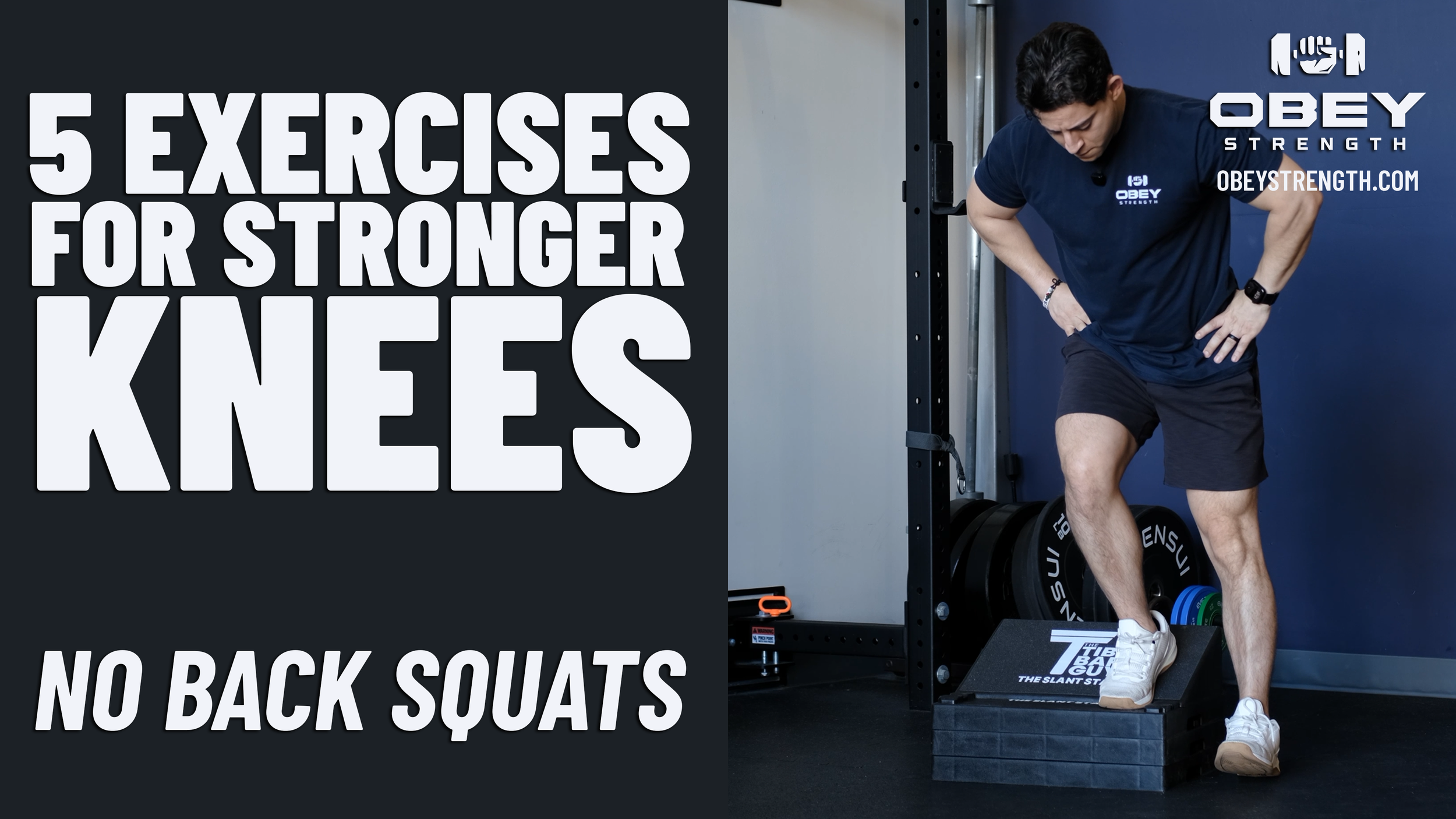
5 Exercises for Stronger Knees That Aren’t Back Squats
Your Knees Need More Than Squats: 5 Exercises for Stronger Knees
The barbell back squat is often called the king of all exercises, and for good reason.
Squats train multiple muscle groups, allow you to progressively lift heavier loads, and can help develop stronger legs, hips, and knees, and an overall stronger body. Barbell back squats are one of my favorite exercises, and I personally believe that squatting is one of the best movement patterns you can include in a well-rounded strength program.
We squat all the time. When we sit down in a chair and stand back up. When we squat down to pick something up. Even when you squat to sit on the toilet!
However, the barbell back squat is just one of many ways to build strong knees.
Many people struggle to learn proper back squat form and technique, while others may be limited by ankle mobility, hip mobility, shoulder positioning, low back pain, previous injuries, or the equipment available to them.
As a physical therapist and online strength coach, I hear it all the time from my clients. “I don’t like squats”, “they hurt my knees and back,” etc., etc.
Squats are not for everyone, and they don’t need to be part of your programming to build strong knees.
Even people who can back squat comfortably can benefit from non-squat exercises in their training.
Your knees do much more than bend and straighten while your feet remain evenly planted underneath a barbell. They help you walk, run, jump, land, climb stairs, change direction, absorb force, and maintain balance on one leg.
To build strong, resilient, and athletic knees, your training should prepare you for more than one exercise.
Strong Knees Require More Than One Movement Pattern
Most traditional squatting and lunging exercises primarily take place in the sagittal plane, which involves forward and backward movement.
The sagittal plane is extremely important. It includes movements such as squatting, hinging, lunging, running, and jumping.
However, sports and everyday activities also require movement in the frontal plane, which involves side-to-side motion, and the transverse plane, which involves rotation.
Your knees must be able to tolerate and control forces coming from multiple directions. If your knees are not prepared for the demands of everyday activities and sports, they can become injured, preventing you from performing said activities.
This does not mean you need to perform complicated exercises while balancing on unstable equipment. It simply means your program should include a combination of bilateral strength, single-leg strength, quadriceps and hamstring training, lateral movement, jumping, landing, and deceleration.
Here are five effective ways I like to help my clients build stronger knees without relying solely on back squats.
1. Lunges for Single-Leg Knee Strength
Lunges are one of the best alternatives or additions to traditional squats.
Unlike a back squat, lunges allow you to train each leg more independently. This can help improve single-leg strength, balance, coordination, and control while requiring less total external weight to challenge the legs.
There are several effective lunge variations, including:
Deficit lunges
Reverse lunges are often a great starting point because many people find them easier to control than forward lunges.
Lateral lunges are especially valuable because they introduce frontal-plane movement. They challenge the quadriceps, glutes, adductors, hips, and knees in a side-to-side position that is not heavily trained during a traditional squat.
2. Bulgarian Split Squats for Quadriceps and Hip Strength
The Bulgarian split squat, also known as the rear-foot-elevated split squat, is one of my favorite exercises for developing lower-body strength.
It’s also one of the most hated exercises in the gym community, in a good way, mostly because of how brutally challenging they are. Trust me, you’ll get a good quad pump from this one!
The front leg is the primary mover and heavily challenges the quadriceps, glutes, hips, and muscles responsible for controlling the knee.
Since the Bulgarian split squat is a single-leg exercise, you can load the exercise with less weight and still create a significant strength stimulus similar to the back squat.
Here’s are a few variations:
3. Hamstring Curls for Direct Knee-Flexion Strength
The quadriceps are extremely important, but the hamstrings (muscles on the back of the leg) also play a major role in knee strength and function.
The hamstrings bend the knee and help control the lower leg during activities such as running, sprinting, jumping, landing, and changing direction.
Hamstring curls directly train knee flexion, which is a muscle action that squats and hip hinges do not fully challenge.
Some of my favorite variations to train the hamstrings through curls are:
4. Stiff-leg Deadlifts for Hamstring and Hip Strength
Stiff-Leg Deadlifts strengthen the hamstrings through a hip-hinge and extension movement.
The hamstrings perform knee flexion at the knee, and hip extension at the...well, hip.
While hamstring curls train the hamstrings by bending the knee, Stiff-Leg deadlifts challenge them primarily through hip extension.
A good exercise program involves training ther hamstrings through both of their actions.
Stiff-Leg deadlifts also strengthen the glutes, back, grip, and trunk while teaching you how to properly hinge at the hips.
Some of my favorite ways to perform Stiff-Leg Deadlifts include:
The focus is on getting a big stretch of the hamstrings when lowering the weight while maintaining a straight back, and then squeezing the hamstrings and glutes to stand back up.
5. Jumping and Landing Drills for Multidirectional Knee Control
Strength exercises help you produce force, but strong knees must also be able to absorb and control force.
This is where jumping, landing, hopping, and deceleration exercises become important.
You do not need to begin with high boxes, maximum-effort jumps, or exhausting plyometric workouts.
Start with basic drills that teach you to land quietly, maintain your balance, and control the position of your hips, knees, and feet.
Some of my favorite jumping and landing exercises include:
You Do Not Have to Abandon Squats
Barbell back squats are NOT bad or unnecessary.
Squats remain one of the best exercises available for developing lower-body strength. However, they are only one tool.
Your knees benefit from a variety of movements, loads, positions, speeds, muscle actions, and directions.
A complete strength program should include bilateral exercises, single-leg training, direct quadriceps and hamstring work, hip-dominant movements, lateral movement, and eventually some form of jumping and landing when appropriate.
Are You Deadling with Knee pain?
If you're dealing with knee pain or any pain or want to prevent future injuries while getting stronger, I offer 1-on-1 virtual training designed to help you build strength, improve mobility, and return to the activities you love pain-free.
My online coaching includes personalized strength and rehab plans by a Doctor of Physical Therapy tailored to your goals, weekly check-ins, and direct support from me, all at an afforable cost.
👉 Click here to get more informationor use the link to get started: obeystrength.com/coaching
Let’s work together to rebuild your strength from the ground up.